
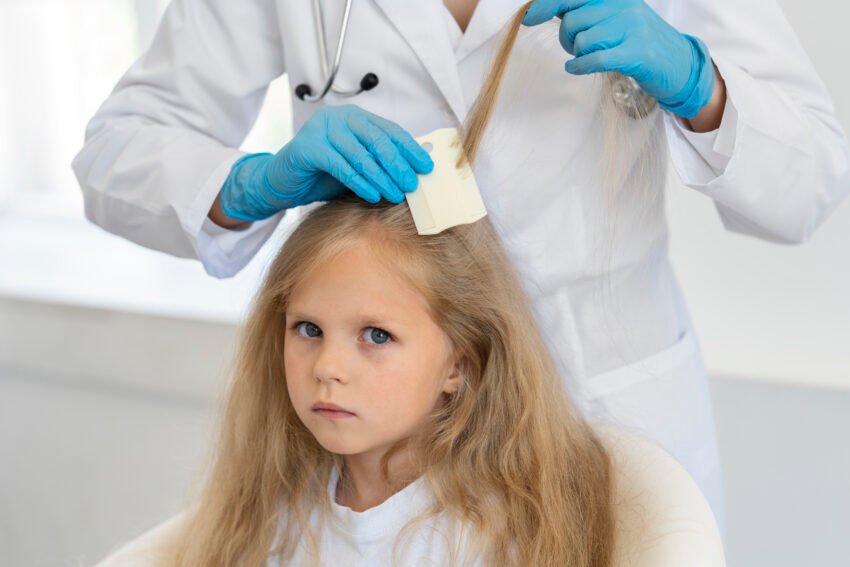

There is a very specific sequence of events that happens when a parent discovers head lice. First, there is the shock. Then, the denial (“maybe it’s just dandruff?”). Then, the horrifying realization that it is, in fact, a bug, and finally, the immediate, overwhelming urge to burn the house down.
Okay, maybe not literally burn it down. But the instinct to purge is primal. You find a louse on your child’s head, and your brain immediately screams, They are everywhere. You envision them crawling on the sofa, hiding in the carpet, and nesting in the stuffed animals.
So, you go to war. You strip every bed in the house. You bag up fifty stuffed animals. You vacuum the curtains. You scrub the baseboards. You spend eight hours turning your home into a sterile operating theater. But here is the uncomfortable truth that nobody tells you while you are hyperventilating in the laundry room: All that cleaning might actually be the reason you can’t get rid of them.
It sounds counterintuitive. How can a cleaner house be a bad thing? The problem isn’t the cleanliness itself; it’s the distraction. By focusing your limited energy on the environment, you are fighting the wrong battle. And while you are busy vacuuming the backseat of your car for the third time, the real enemy is happily thriving exactly where you left it—on your child’s scalp.
Before you have a nervous breakdown over a pile of laundry or rush to a professional lice treatment clinic in a panic, take a deep breath. Put down the bleach wipes. Here is why you need to stop cleaning your house and start focusing on the head.
The Biology of the “Wimpy” Bug
To understand why the deep clean is a waste of time, you have to understand the bug itself. Head lice are evolutionarily designed to do one thing: hold onto human hair. That is it. They are not like fleas that jump from the carpet to your ankles, and they are not like bed bugs that hide in your mattress seams waiting for nightfall.
A head louse is surprisingly fragile. It requires a human host to survive.
- Food: They need to feed on human blood several times a day. If a louse falls off a head, it will starve to death within 24 to 48 hours.
- Temperature: They need the warmth of the human scalp to incubate their eggs. If an egg falls off a hair strand onto the pillow, it will not hatch. It creates a “failure to launch” scenario because the ambient room temperature is too cold.
This means that the louse you found on the couch cushion isn’t a master strategist waiting to ambush you. It’s a dying bug. It is weak, dehydrated, and effectively harmless.
The Opportunity Cost of Cleaning
This is where the paradox kicks in. Lice removal is a marathon, not a sprint. It requires patience, good lighting, and painstaking attention to detail.
If you spend Saturday morning washing ten loads of laundry, vacuuming every rug, and wiping down the walls, you are going to be exhausted by 2:00 PM. Then, you finally sit your child down to do the actual removal—the combing. Because your back hurts and your patience is frayed from the cleaning spree, you rush the comb-out. You spend 20 minutes instead of an hour. You miss five or six microscopic nits hiding behind the ears because your eyes are tired.
Those five nits hatch three days later. The cycle restarts. You think, “They must have come from the couch!” So you clean the couch again. In reality, they never left the head. The cleaning distracted you from the only task that actually mattered.
The Reinfestation Myth
Parents often obsess over the idea of reinfestation from the home. We have this movie-style image of bugs crawling from the pillow back onto the child’s head at night.
The risk of transmission from inanimate objects is extremely low. Lice don’t have back legs designed for walking on smooth surfaces; they have claws designed for gripping hair shafts. A louse on a pillowcase is like a fish out of water—it’s struggling. It is highly unlikely to crawl across a cotton sheet, navigate the vast distance to a sleeping child, and climb back up.
Transmission is almost exclusively head-to-head contact. It’s the hug, the selfie, the whispering of secrets. It isn’t the carpet.
The Reasonable Cleaning Checklist
Does this mean you should live in squalor? Of course not. Hygiene makes us feel better, and there are a few common-sense steps you should take. But you can cut your cleaning list by about 90%.
The Do List (Takes 20 Minutes):
- Bedding: Strip the sheets and pillowcases from the bed the infested person slept in last night. Wash them on hot and dry on high heat. That’s it. You don’t need to wash the comforter or the mattress pad unless they sleep directly on it.
- Hair Brushes: Gather up all the hairbrushes, combs, and hair ties. Pick out the hair, and then soak them in hot water (130°F) for 10 minutes. Or just run them through the dishwasher.
- The Favorite Item: If your child sleeps with one specific stuffed animal every night, toss it in the dryer on high heat for 30 minutes.
The Don’t Bother List (Save Your Sanity):
- Bagging Toys: Do not bag up every toy in the house for two weeks. Lice don’t eat plastic, and they don’t live on teddy bears.
- Vacuuming Everything: A quick pass on the floor is fine, but you don’t need to vacuum the curtains, the car seats, or the mattresses.
- Spraying Furniture: Do not spray pesticides on your sofa. It’s toxic to your kids and pets, and it does absolutely nothing to the nits on your child’s head.
The Clean House Paradox
The clean house paradox is a trap. It tricks you into feeling productive while the real problem multiplies on the scalp. The best thing you can do for your family during a lice outbreak is to be lazy about your house and obsessive about your head.
Take the energy you would have spent scrubbing the baseboards and use it to do one more meticulous comb-through. Or, use the money you would have spent on dry cleaning the curtains and put it toward a professional treatment that uses heated air to dehydrate the bugs instantly.
Your house will survive a few days of dust. But your sanity might not survive another month of lice. Keep your eye on the prize (the head), and let the laundry wait.