
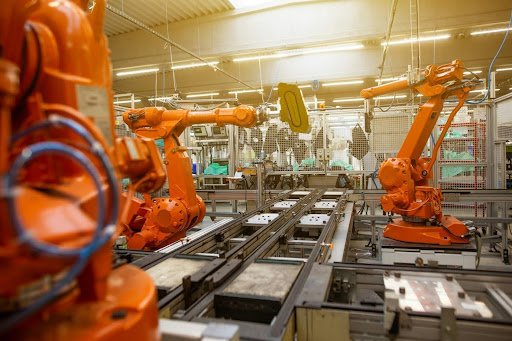

Warehouses face some of the highest employee turnover rates. Many warehouse operations see annual turnover above 40 percent. This has become a structural risk that threatens service levels, margins and overall supply chain resilience. To address this gap, warehouse leaders are turning to collaborative robotics (cobots).
Cobots provide worker augmentation by addressing three key areas: reducing physical strain, improving job satisfaction and stabilizing frontline teams. This guide explains how cobots enhance human work and help close the warehouse labor gap.
How do collaborative robots fundamentally differ from traditional industrial robots, and why are they better suited for addressing the labor gap?
Traditional industrial robots are built for fenced-off environments. They are fast, powerful and inflexible, typically programmed to repeat one task thousands of times with little variation. That makes them effective for automotive lines, but poorly suited for most warehouses.
Cobots are fundamentally different. They are smaller, sensor-rich, and are designed for safe human-robot collaboration. Force limiting, vision systems and real-time obstacle detection allow them to operate alongside people without cages. This is especially true when integrating warehouse robotics, guided by the warehouse management experts at Freeport Center. They are easier to deploy, reprogram and relocate as demand shifts.
This flexibility is why cobots fit modern supply chain automation strategies. Warehouses today need systems that adapt weekly, sometimes daily. Cobots can be deployed in weeks, not years, and scaled incrementally rather than through massive capital projects.
What specific, repetitive or ergonomically challenging tasks are cobots most effectively deployed to handle in a typical warehouse setting?
Cobots shine in tasks that are repetitive, physically taxing or prone to error when done at speed. In e-commerce fulfillment, picking assistance is one of the most common applications. Autonomous mobile robots can follow pickers, present totes and eliminate miles of daily walking. This alone can boost pick rates by 20 to 30 percent while reducing fatigue.
Packing and palletizing are another strong fit. Cobots can handle repetitive lift-and-place motions, especially at awkward heights, reducing the risk of strain injuries. In sortation, cobots equipped with vision systems can handle simple decision-making tasks, such as sorting cartons by size or destination.
The key is not full automation of the process, but smart division of labor. Humans handle judgment, exceptions and quality control. Cobots handle the grind. The result is higher warehouse productivity without burning out staff.
What is the typical Return on Investment (ROI) timeline for implementing cobot systems, considering initial costs versus reduced reliance on temporary labor?
Most cobot deployments deliver ROI within 12 to 18 months. Upfront costs typically include the cobot itself, system integration and employee training. These investments are often offset quickly by reduced overtime, lower reliance on temporary labor and fewer injury-related absences.
ROI timelines can be significantly shorter in environments where cobots replace high-turnover, repetitive or physically demanding temporary labor. Cobots provide stability to the logistics workforce by operating consistently and reducing physical strain. This allows experienced employees to remain productive longer, compounding returns and making cobots a durable investment rather than a short-term cost fix.
How does the introduction of cobots impact existing human staff, addressing concerns about job displacement while focusing on upskilling and improved job satisfaction?
Job displacement is the biggest concern for frontline teams. However, cobots rarely eliminate jobs. Instead, they change them. Workers move from pure manual labor into roles that involve monitoring, coordinating and optimizing workflows.
This shift supports upskilling. Associates learn basic robot operation, troubleshooting,and data interpretation. These are transferable skills that improve retention because employees see a future, not just a physically demanding job. In facilities that implement cobots well, morale often improves because work becomes safer and more sustainable.
What are the primary safety standards and operational training requirements necessary for integrating cobots safely into a human-heavy environment?
Safe integration is non-negotiable. Cobots must comply with ISO 10218 and ISO/TS 15066, ISO 12100 and relevant ANSI/RIA R15.06 guidelines. These standards define limits on force, speed and contact to ensure safe operation around humans and guide risk assessments for collaborative workflows.
Training is equally important. Operators need instruction on normal operation, emergency stops and basic maintenance. Supervisors must understand risk assessments and workflow design. When safety and training are treated as core parts of deployment, cobots become trusted teammates rather than perceived hazards.
Conclusion
The labor crisis is not temporary. Warehouses that rely solely on hiring their way out will continue to struggle. Collaborative robotics (cobots) offer a practical, human-centric alternative that enhances, rather than replaces, the existing workforce, particularly when supported by warehouse management experts at Freeport Center.