

Key Takeaways
- Measure the bathtub shower door opening in three spots—top, middle, and bottom—because tub walls and surrounds are rarely perfectly straight, and the smallest number is usually the one that matters.
- Check plumb and level before buying any glass bathtub shower door, especially frameless or semi-frameless models, since even a 1/4-inch wall lean can change what will fit.
- Match the bathtub shower door style to the space: sliding doors work better in tight bathroom layouts, while hinged options need clear floor space and inside tub clearance to swing safely.
- Use finished opening size, not the tub’s nominal size, when ordering a shower/tub combo door, or the installation can go sideways fast.
- Account for track clearance, tub lip depth, wall surround thickness, and faucet trim before choosing a bathtub shower door, because those small misses are what usually stall DIY installs.
- Pick a bathtub shower door that fits both daily use and resale photos—clear glass and simple modern trim tend to make a small bathroom look bigger and cleaner in listings.
Most bathtub shower door returns happen for one boring reason: the opening wasn’t measured right the first time. Not cracked glass. Not bad hardware. Just numbers taken too fast, off the wrong edge, or from a tub that wasn’t as level as it looked. For DIY homeowners replacing an old enclosure, that mistake can kill a weekend, blow the budget, and leave the bathroom half-finished.
In practice, the measuring part should take about 15 minutes—not an afternoon—if the right points get checked in the right order. And that matters more now, because buyers are seeing more options than ever: frameless glass, semi-frameless panels, sliding doors, hinged doors, even walk-in shower/tub combo setups that look sharp in listing photos and still make sense for daily use. But here’s what most people miss: a bathtub opening almost never measures the same at the top, middle, and bottom. Add an uneven wall surround or a tub ledge that’s slightly out of plumb, and a “standard” size suddenly isn’t standard at all.
Why accurate bathtub shower door measurements matter before any remodel or installation
Think a bathtub shower door measurement can be eyeballed in five minutes? It can’t. For DIY owners replacing an old surround or planning a remodel, an error as small as 1/4 inch can turn a simple installation into a return, a wall adjustment, or a glass panel that won’t clear the tub lip.
How a bad measurement can ruin a bathtub shower door installation
A bad read usually shows up late—after the old doors are out and the bathroom is half torn apart. The most common failures are simple:
- Width taken at one point only
- Out-of-plumb walls ignored
- Tub deck slope missed
That’s how a sliding bathtub shower door binds, leaks inside the enclosure, or leaves gaps over the bathtub edge. A crooked opening can also ruin a glass bathtub shower door install, especially on an alcove shower/tub combo with older walls.
Which bathtub shower door styles change the way you measure
Not all doors measure the same. A frameless bathtub shower door usually demands tighter wall and height checks, while a framed or semi-frameless model may allow a little adjustment. Hinged doors need swing clearance; sliding doors need overlap width; corner and walk-in conversion layouts change where the base and wall are checked.
And an easy clean bathtub shower door only stays easy to clean if the panels line up right and water stays where it belongs.
The 15-minute measuring goal DIY homeowners can actually hit
Fifteen minutes is realistic—if they measure in this order:
Worth pausing on that for a second.
- Width at top, middle, bottom
- Height on both walls
- Wall plumb with a level
- Tub edge depth and slope
That quick process works better than guessing from an old door, and it helps narrow modern bathtub shower door ideas fast.
What tools to grab before measuring a bathtub shower door opening
A homeowner pulls the old tub doors off, grabs a tape measure, and gets three different numbers in five minutes. That’s normal. A bathtub shower door opening can shift at the wall, the tub deck, and even the floor, so the right prep matters before any remodel order gets placed.
The basic measuring kit for a glass bathtub shower door project
For a clean measuring pass, the kit should stay simple:
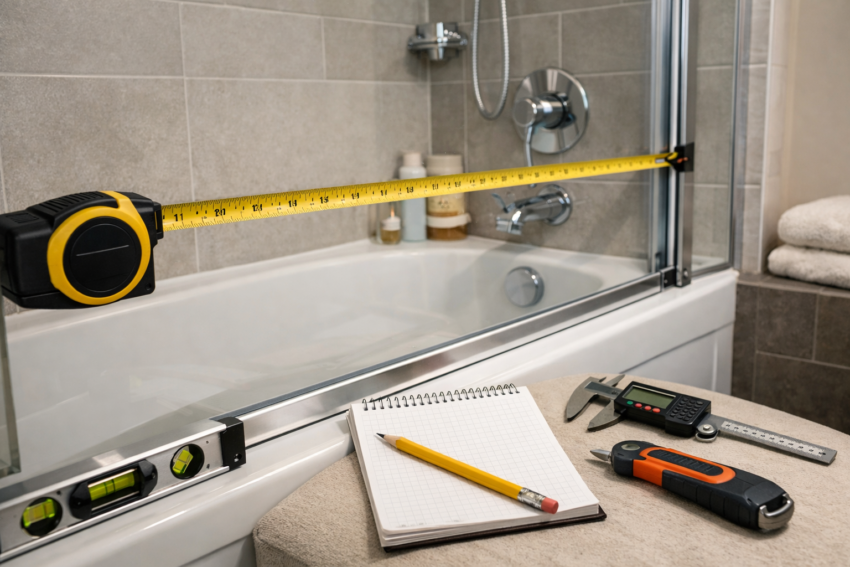
- 25-foot tape measure
- 4-foot level
- Small torpedo level
- Painter’s tape
- Notepad or phone notes
A glass bathtub shower door needs width measured at the top, middle, and tub base—then height on both walls. If the plan is a sliding bathtub shower door, those three width points matter even more because bypass doors don’t hide an out-of-square alcove well.
How to check if your tub, wall surround, and floor are level and plumb
Start with the tub deck. Then check each wall jamb for plumb with a 4-foot level. A frameless bathtub shower door usually gives less forgiveness than framed doors, so anything over 1/4 inch out of plumb across the opening should be flagged before installation.
Most guides gloss over this. Don’t.
And yes, the floor still matters, even on a shower/tub combo, because a leaning tub apron or uneven surround can throw off door alignment (especially with modern glass).
When prefab enclosures, alcove tubs, and corner setups need extra checks
Prefab surround panels, alcove tubs, corner units, and walk-in conversion layouts need one extra look at bowed walls and inside corner flare. An easy clean bathtub shower door works best when rollers, tracks, or hinges aren’t fighting a twisted opening. In practice, one quick recheck saves the return headache.
How to measure a bathtub shower door for sliding, hinged, and frameless glass options
Roughly 1 in 4 shower door returns trace back to bad measuring, not bad products—and the mistake usually happens in the first three minutes. For a bathtub shower door, the right approach is simple: measure the opening, not the old doors, and check every point where glass, track, and wall meet.
Measuring width at the top, middle, and bottom of the bathtub opening
Start with width. Measure the tub opening at three spots: top, middle, and bottom. Write down all three numbers for any sliding bathtub shower door, because an alcove surround can pinch inward and throw off the fit.
- Use the smallest width as the working number
- Measure wall to wall, not trim to trim
- Check inside the enclosure where the track or jamb will actually sit
Measuring height for bathtub shower door glass panels and track clearance
For height, measure from the tub ledge to the top point where the header, hinged hardware, or glass panel will end. A glass bathtub shower door needs enough clearance over the surround and enough room for safe installation without clipping a ceiling slope or corner shelf.
How to account for out-of-plumb walls, uneven tub ledges, and surround thickness
Walls are rarely perfect.
Hold a level on both walls—if one leans even 1/4 inch, a frameless setup gets less forgiving fast. That’s why buyers looking at a frameless bathtub shower door should also measure ledge depth and note any uneven floor line or prefab surround lip.
Measuring for walk-in, semi-frameless, and modern shower/tub combo doors
For walk-in, semi-frameless, and modern shower/tub combo doors, check these before ordering:
Most guides gloss over this. Don’t.
- Entry width for walk access
- Glass swing path for hinged doors
- Track clearance for sliding models
- Ledge width for an easy clean bathtub shower door
Small detail. Big difference.
Choosing the right bathtub shower door based on your measurements and bathroom layout
Think of this like a coffee chat with a smart friend: once the opening width, tub lip depth, and ceiling clearance are measured, the right bathtub shower door choice gets a lot easier. In practice, layout drives the pick more than style alone—especially in a small bathroom remodel where every inch over the tub matters.
Best bathtub shower door picks for small bathroom remodel plans
For tight alcove or combo layouts, a sliding bathtub shower door usually makes the most sense because it doesn’t swing into the floor space. A glass bathtub shower door also keeps the bathroom feeling open, which helps small surround and prefab conversion projects look less boxed in.
- Best for narrow clearances: sliding doors
- Best for clean visual lines: frameless or semi-frameless
- Best for easy upkeep: easy clean bathtub shower door
Sliding vs hinged vs frameless bathtub shower doors for ROI and daily use
Bluntly, hinged doors look sharp but need swing room. That’s a problem in a walk-in bathroom with a vanity parked too close. A frameless bathtub shower door photographs like a higher-end remodel—especially with modern tile—but thicker glass can make installation less forgiving.
What photographs better in listings: clear glass, modern black trim, or simple chrome
Clear glass wins most listing photos because it shows off the shower/tub surround inside. But here’s the thing—modern black trim pops in photos, while simple chrome has broader buyer appeal and usually ages better in rental turns. If resale is the goal, clean lines beat fussy hardware. Every time.
The most common bathtub shower door measuring mistakes buyers make right before purchase
Bad measurements ruin this project.
And the mistake usually happens after the buyer finds a style they like—then assumes the opening will match the listing. It often doesn’t.
Ordering by nominal size instead of finished opening size
A bathtub shower door should be ordered by the finished opening, not the rough product label or the old door size. A listing may say 56 to 60 inches, but the real wall-to-wall width after tile, surround panels, or an alcove remodel can land at 57 3/8. That difference matters for a glass bathtub shower door, especially a modern sliding or hinged enclosure.
- Measure width at the top, middle, and tub lip
- Use the smallest number
- Write down height from tub deck to intended top rail
Ignoring towel bars, faucets, trim, and inside clearance over the tub
Clearance gets missed all the time. A sliding bathtub shower door may fit the opening but still hit a faucet, corner shelving, or trim inside the shower/tub combo. On a walk-in setup, even 1 inch of interference can stop full door travel. Buyers also forget whether a towel bar projects into the path of the doors.
Forgetting tub lip depth, wall material, and installation tolerance before checkout
This is where returns start. A frameless bathtub shower door often needs flatter walls and tighter tolerance than framed prefab doors, while an easy clean bathtub shower door still depends on enough tub lip depth for secure base mounting. Before checkout, confirm:
- Tub lip depth
- Wall material—tile, fiberglass, or drywall behind surround panels
- Plumb variation across both walls
In practice, even a 1/4-inch out-of-plumb wall can change the installation plan.
This is the part people underestimate.
Frequently Asked Questions
What is the best type of bathtub shower door for a standard tub?
For a standard alcove bathtub, the best bathtub shower door is usually a sliding glass door or a hinged door, depending on clearance. Sliding doors work better in a small bathroom because they don’t swing out over the floor, while hinged options feel cleaner and more modern if the room has enough space.
Are frameless bathtub shower doors worth it?
Usually, yes. A frameless bathtub shower door photographs better, makes a shower/tub combo look less dated, and gives even a prefab surround a more expensive finish. The catch is installation has to be more precise—walls out of plumb and uneven tub edges show up fast.
Can a bathtub shower door be installed on any tub?
No, and that’s what people miss. A bathtub shower door needs a flat, level mounting surface on the tub deck and stable wall material for the side rails or hinges, so old jacuzzi tubs, clawfoot setups, and some freestanding or corner models usually aren’t a fit without a conversion or custom enclosure.
Is a sliding or hinged bathtub shower door better?
For daily use, sliding bathtub shower doors win in tight layouts because they don’t need walk space in front of the tub. Hinged doors are easier to clean inside — tend to feel more current, but they need swing clearance and they can drip water onto the bathroom floor if the install is sloppy.
What glass thickness should a bathtub shower door have?
Most good-quality bathtub shower door systems use tempered glass in the 1/4-inch to 3/8-inch range. For a framed or semi-frameless door, 1/4-inch glass is common and plenty sturdy; for frameless designs, thicker glass usually looks better and feels more solid in hand.
How much does bathtub shower door installation cost?
If a homeowner doesn’t DIY, bathtub shower door installation often runs a few hundred dollars just for labor, and that can climb if walls are uneven or the surround needs prep first. In practice, the install can cost nearly as much as the door on entry-level models—which is exactly why DIY buyers pay close attention to whether the hardware is installation-friendly.
The difference shows up fast.
Do bathtub shower doors work better than a shower curtain?
For resale photos and everyday cleanup, yes. A glass bathtub shower door looks more finished, helps a bathroom remodel read as updated, and avoids the mildew-prone curtain problem, though a curtain still makes sense for odd tubs, doorless plans, or a temporary renovate-and-sell project with a very tight budget.
What’s the best bathtub shower door for a small bathroom?
A sliding glass bathtub shower door is usually the safest pick for a small bathroom. It keeps the walkway clear, works well over an alcove bathtub, and gives the room a lighter look than a framed combo with bulky trim.
Can you put a shower door on a bathtub shower combo during a remodel?
Yes—if the tub, walls, and surround are in good shape and measured correctly. During a remodel, this is often one of the smartest upgrades because swapping an old curtain rod for a clean glass enclosure changes the whole look of the bathroom without the cost of a full walk-in conversion.
What should homeowners check before buying a bathtub shower door?
Start with three things: opening width, tub ledge depth, and wall condition. Then check whether the door is meant for an alcove setup, whether it’s framed, semi-frameless, or frameless, and whether the hardware finish fits the rest of the bathroom—because a modern glass door can still look off if the details fight each other.
A bathtub shower door project usually goes sideways for one simple reason: people buy the door first and measure the opening second. That order costs time, money, and a lot of avoidable frustration. The smarter move is faster, too. A tape measure, a level, and 15 focused minutes are enough to catch the details that actually decide fit—width changes from top to bottom, wall lean, tub ledge depth, and the clearance around trim and hardware.
That part matters more than style trends. Sliding doors can save space, hinged panels need swing room, — frameless options look sharp in listing photos, but none of them work well if the finished opening size is off by even half an inch. Here’s what most buyers miss: the best-looking choice is the one that fits cleanly, installs without shims piled everywhere, and doesn’t fight the room every day.
Before ordering any bathtub shower door, the reader should write down top, middle, and bottom width measurements, note the smallest number, confirm height and plumb, then compare those numbers against the manufacturer’s installation specs—not the nominal size on the product page. Do that first. Buy once.
For more great reading, visit our site and explore related topics.