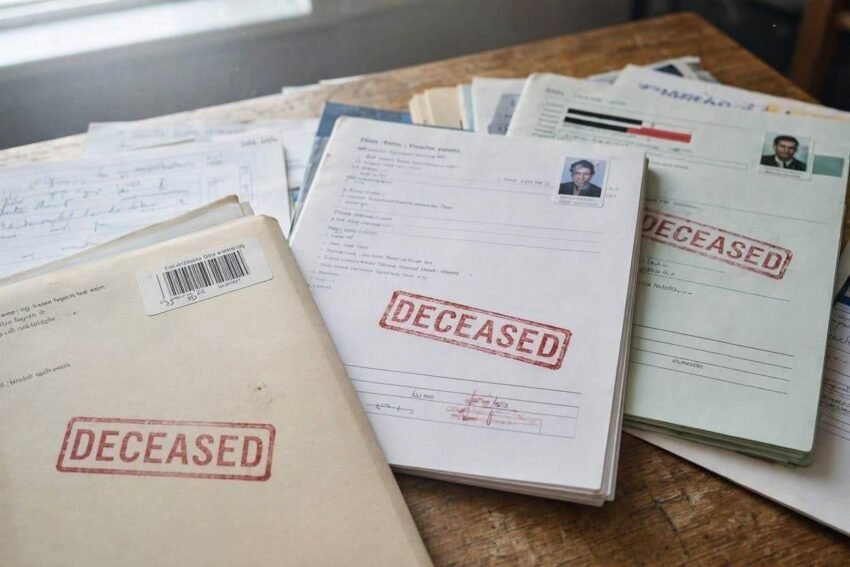

The government alleges false electronic records made nursing evaluations, terminal-illness certifications, and hospice care appear to have occurred before recently deceased beneficiaries died, allowing claims to enter Medicare under seemingly valid service timelines
WASHINGTON, DC — Federal prosecutors allege Los Angeles hospice operator Oren David Shachar directed the creation of false, backdated electronic medical records so Medicare would receive claims suggesting recently deceased beneficiaries had entered hospice and received qualifying care while they remained alive.
The accusation focuses upon chronology as much as identity, because the government says authentic names and Medicare numbers were combined with invented earlier events, transforming information about real deceased people into files portraying nurse evaluations, physician certifications, enrollments, and services that allegedly never happened.
According to the federal indictment describing the alleged backdating process, Shachar instructed a nurse, an unnamed physician, and others to create records stating beneficiaries were examined before death and properly certified as terminally ill for Medicare hospice coverage.
Shachar, Jeannie Choi, and Abraham Shin remain presumed innocent, and prosecutors must prove every charged agreement, record, identity use, claim, payment, and required mental state beyond a reasonable doubt through admissible evidence tested within federal court.
Backdating Is the Center of the Deceased-Patient Theory
The headline shorthand describes backdated enrollments, although the indictment uses more precise language by alleging that electronic medical records were backdated, while separately asserting that meetings were arranged with surviving relatives to obtain hospice enrollment paperwork after the beneficiaries had died.
That distinction matters because a hospice may lawfully finish documentation or submit a claim after a patient’s death for genuine care previously delivered, whereas prosecutors allege these records falsely moved nonexistent examinations and certifications backward in time to create eligibility that never existed.
The disputed question is therefore not whether Medicare processed paperwork after death, an ordinary occurrence throughout healthcare, but whether the underlying admission, clinical assessment, physician judgment, election, and billed services genuinely occurred on the earlier dates represented within each patient file.
If prosecutors establish that records were deliberately assigned false dates, they can argue chronology was used as a material deception designed to make Medicare believe statutory and program conditions had been satisfied before reimbursement reached one of Shachar’s four hospice companies.
The Alleged Workflow Began with Death Information
Prosecutors say Choi obtained identifying information through her employment at an unnamed California-licensed funeral business, then Choi and Shin allegedly transmitted names, Social Security numbers, birth dates, Medicare identifiers, identification photographs, death details, physician names, and next-of-kin contacts to Shachar.
Those materials allegedly traveled through text messages and WhatsApp, potentially providing investigators with timestamps, attachments, account identifiers, surrounding conversations, and transmission sequences that can be compared against funeral intake records, medical requests, hospice admissions, payments, and later claims.
Shachar allegedly determined whether each deceased individual had Medicare coverage and could have qualified for hospice benefits while alive, after which he, Choi, a nurse, or others purportedly contacted surviving relatives to collect additional health information.
Office employees allegedly requested records from recent hospital visits, supplying diagnoses, medications, attending physicians, functional information, and treatment history that could make a retrospectively constructed hospice narrative appear medically plausible despite the absence of a contemporaneous assessment.
Real Information Could Support Invented Events
The government’s theory does not describe fabricated people, because prosecutors instead allege that genuine beneficiary identities, authentic death information, and real medical histories were assembled around clinical encounters and hospice activities that had not actually occurred.
That combination can be difficult to detect because databases may successfully verify the beneficiary’s name, age, Medicare eligibility, physician relationships, and recent hospitalization even while the claimed nurse visit, hospice election, terminal prognosis, or service date remains false.
Identity validation alone consequently cannot establish claim validity, since a billing system must also determine whether the person was alive on the represented date, whether the clinician performed the documented work, and whether the required authorization and services existed contemporaneously.
The alleged method illustrates why healthcare fraud investigations often move beyond surface consistency and examine whether several independent records converge upon the same real-world event rather than merely repeating information copied from a common source.
Hospice Eligibility Requires More Than an Approaching Death
Medicare hospice coverage generally depends upon a physician-supported terminal prognosis, commonly reflecting an expected life span of six months or less if the illness follows its ordinary course, together with an informed election emphasizing comfort-oriented care.
A patient’s death soon after a purported admission may appear consistent with terminal eligibility, but death itself cannot retroactively prove that an authorized physician reached the required judgment, that the beneficiary elected hospice, or that covered care was delivered beforehand.
Prognosis remains a clinical judgment rather than a guaranteed prediction, meaning legitimate patients may survive longer than expected, while a deceased person’s medical history could still contain serious illnesses without proving any particular hospice enrollment actually occurred.
Prosecutors must therefore establish both impossibility and intent through evidence showing the recorded encounters were invented, the defendants knew the beneficiaries were already dead, and claims relied materially upon the false chronology rather than an innocent administrative error.
Late Documentation Is Not Automatically Fraudulent
Healthcare organizations sometimes permit late entries, corrections, addenda, or delayed signatures when a clinician documents genuine earlier work, but compliant systems ordinarily preserve the actual creation time, identify the author, explain the delay, and avoid disguising a later entry as contemporaneous.
Backdating becomes materially different when someone knowingly changes a date to represent that an examination, certification, consent, or service occurred earlier than it did, especially when the patient had already died and could never have participated in the documented encounter.
Defense lawyers may argue that questioned records were lawful late entries, imported documents, corrected templates, delayed electronic signatures, or administrative reconstructions based upon genuine care, requiring prosecutors to prove falsity rather than relying solely upon a mismatch between service and entry dates.
Jurors may need expert explanations distinguishing a visible addendum entered after death from an entry allegedly designed to conceal its true creation time, because the same calendar discrepancy can carry very different meanings depending upon system behavior and documented purpose.
Electronic Metadata Could Reconstruct the Sequence
Electronic health platforms may preserve creation timestamps, modification histories, user credentials, signature events, template versions, imported attachments, claim exports, access locations, and deletion activity, allowing investigators to test when each disputed record first entered the system.
Investigators can compare those logs with death times, employee schedules, telephone records, messages, family meetings, hospital requests, payment transfers, and Medicare submissions, building a chronology that may either support or undermine the allegation of deliberate retrospective fabrication.
Technical evidence remains contestable because shared passwords, incorrect system clocks, software migrations, time-zone conversions, delayed synchronization, vendor maintenance, copied templates, and incomplete audit exports can sometimes produce suspicious timestamps without reliably identifying the person responsible.
The most persuasive proof would connect a specific instruction from Shachar with a particular beneficiary, a record created after death, an earlier false service date, a clinician who denies performing the encounter, and a resulting Medicare claim.
Exact Death Times Allegedly Became Operational Data
The indictment alleges Shachar insisted that the funeral business preserve accurate dates and times of death so his organization could prepare its own records and arrange meetings with next of kin to sign hospice enrollment paperwork.
Prosecutors may argue that precise death information allowed participants to place invented events inside a narrow earlier window, avoid service dates that obviously followed death, and coordinate medical narratives with hospital discharge or funeral records likely to receive later scrutiny.
Defense attorneys can respond that funeral and healthcare businesses routinely require accurate death information for legitimate administrative purposes, making the surrounding communications, payment evidence, record changes, and witness testimony essential for establishing why Shachar allegedly requested those details.
The evidentiary significance will depend upon whether death times were merely collected or actively used to select false service dates, direct record entries, obtain signatures, and support claims that otherwise lacked genuine contemporaneous documentation.
Selection Rules Allegedly Reduced Conflicting Evidence
Prosecutors claim Shachar accepted deceased referrals only when individuals died at home rather than inside hospitals or facilities, died within five days after marketer contact, and were not receiving hospice from another provider when death occurred.
Those alleged restrictions could support an inference that the organization wanted short, plausible billing windows with fewer institutional records, witnesses, or competing hospice files capable of contradicting a newly constructed admission and service chronology.
A home death might leave a less concentrated institutional record than a hospital death, while the absence of another hospice provider could reduce the likelihood that Medicare systems, relatives, clinicians, or contractors would immediately encounter overlapping claims.
However, the government must prove those rules existed and served a fraudulent purpose, while the defense may contest witness interpretations or identify legitimate operational explanations for declining referrals involving facility deaths, prior providers, or uncertain timelines.
Family Signatures Could Become Critical Evidence
The indictment alleges meetings were arranged with surviving relatives at the funeral business, or relatives were contacted by telephone, so participants could gather personal health information and obtain paperwork connected with the deceased person’s purported hospice enrollment.
Relatives may have understood those contacts differently, perhaps believing they concerned funeral administration, insurance, medical-record releases, final billing, or bereavement services, making the exact documents, disclosures, questions, language, timing, and representative authority important at trial.
Prosecutors could compare signatures, handwriting, electronic acknowledgments, telephone metadata, and witness memories against document dates to determine whether enrollment papers appeared to have been executed while the beneficiary lived but were actually completed afterward.
Defense counsel may challenge signature authenticity, translation, memory, consent, legal authority, or document interpretation, emphasizing that a family member’s post-death involvement does not independently prove every clinical record or claim inside the file was fraudulent.
Three Charged Identity Uses Anchor the Later Allegations
Counts Ten through Twelve charge all three defendants with aggravated identity theft involving the names, Social Security numbers, and Medicare identifiers of beneficiaries identified publicly only by initials, with alleged identity-use dates during August and November 2025.
Those counts correspond with three healthcare-fraud executions involving Art of Hospice, Holly Trinity Hospice, and Gentle Touch Hospice, where the indictment identifies disputed claim amounts of approximately $420, $220, and $850, respectively, for payment.
The three listed amounts total approximately $1,490, but they are charged executions rather than a calculation of every claim involving deceased beneficiaries, preventing readers from treating that narrow total as the complete financial scope of the alleged backdating practice.
Likewise, the approximately $27.731 million billed and $26.908 million paid figures cover the wider alleged scheme involving living and deceased beneficiaries, medical necessity, undelivered services, kickbacks, and four hospices across several years.
The Claim Dates Create Testable Chronologies
The indictment associates two alleged identity uses from August 2025 with hospice claims dated September 1, 2025, while the third alleged identity use and its related Gentle Touch claim share the date November 3, 2025.
Those sequences give investigators concrete periods for collecting messages, electronic access logs, family contacts, record requests, signatures, staff schedules, claim batches, and payments, allowing each count to be evaluated through evidence narrower than the overall conspiracy narrative.
Jurors could accept the government’s proof concerning one beneficiary while finding uncertainty about another, because the existence of one allegedly backdated file does not automatically establish authorship, knowledge, intent, or unauthorized identity use for every separate count.
The defense may also argue that claim-submission dates reflect routine billing cycles rather than service dates, requiring prosecutors to show exactly which represented events were false and how each disputed statement caused Medicare to issue payment.
Four Hospices Allegedly Received the Claims
Prosecutors say Shachar owned or operated Gentle Touch Hospice Care in Valley Glen, Oxford Hospice Care in Montclair, Art of Hospice in Encino, and Holly Trinity Hospice in Glendale, using separate provider identities within the alleged billing operation.
The later counts naming Shachar, Choi, and Shin involve three of those providers, while Oxford appears among earlier healthcare-fraud executions but is not identified in the three aggravated identity-theft counts concerning the protected beneficiaries.
Multiple companies can supply investigators with separate enrollment applications, employee rosters, bank accounts, audit trails, claim histories, and vendor records, enabling comparisons that reveal whether disputed practices were centralized or limited to particular personnel and locations.
Corporate affiliation does not establish criminal responsibility, however, because prosecutors must connect Shachar’s authority with knowing directions and false claims, while separately proving what Choi and Shin understood about the alleged record construction and billing consequences.
Payments Allegedly Connected Referrals with Completed Enrollments
The government alleges Shachar paid Choi and Shin between at least $1,000 and $3,000 for each deceased beneficiary referral enrolled in hospice, creating a financial trail that may be compared with messages, admissions, records, and claims.
Timing could become especially important if a payment followed receipt of death information, completion of a backdated chart, procurement of a relative’s signature, or transmission of a Medicare claim involving the same protected beneficiary.
Defense attorneys may characterize transfers as lawful compensation, reimbursements, loans, or unrelated business payments, requiring prosecutors to establish the purpose of each transaction through records and testimony rather than assuming every transfer represented payment for a deceased identity.
The government may argue that recurring amounts and beneficiary-specific communications reveal a referral marketplace, while the defense can question whether witnesses received cooperation benefits, misunderstood payment descriptions, or attributed decisions to Shachar without personal knowledge.
Death Does Not Automatically Make a Later Bill False
Hospitals, physicians, hospices, pharmacies, and other providers routinely submit valid claims after a patient has died, because administrative processing often follows service delivery and reimbursement timing does not determine whether earlier care was genuine.
A responsible analysis must therefore reject the simplistic proposition that every post-death claim is fraudulent, focusing instead upon whether the billed service dates preceded death, the patient was properly enrolled, and reliable contemporaneous evidence supports actual delivery.
Prosecutors allege the Shachar files crossed that line because records were created to state that nurses saw beneficiaries while alive and a physician certified terminal illness, despite the government’s assertion that those events never occurred.
The defense can prevail on individual counts if it demonstrates genuine earlier services, lawful delayed documentation, authorized corrections, mistaken attribution, or insufficient proof that any defendant knowingly caused Medicare to rely upon materially false information.
Medicare Data Can Reveal Improbable Patterns
Claims analytics can identify unusually short hospice stays, repeated admissions immediately preceding death, high concentrations of home deaths, late-created records, common referral sources, overlapping providers, rapid claim submission, and billing disconnected from documented visit frequency.
No single pattern proves fraud because legitimate hospice populations often include very short stays, emergency referrals, home deaths, and documentation completed during emotionally difficult circumstances, requiring investigators to compare anomalies with patient-level clinical and operational evidence.
The indictment alleges deceased enrollments also helped conceal a high live-discharge rate and address Medicare’s annual aggregate payment cap, giving prosecutors a proposed business motive for adding patients whose records would end predictably after brief purported stays.
Defense experts may dispute those calculations, identify lawful beneficiaries omitted from the government’s framing, or show that statistical patterns arose from referral geography, diagnosis mix, staffing, or changing patient populations rather than intentional manipulation.
Compliance Controls Must Preserve the Original Timeline
Hospice providers should configure electronic systems to retain immutable creation and modification logs, prohibit users from overwriting original service dates, require labeled addenda, document correction reasons, and escalate any entry first created after a patient’s death.
Every admission should connect verified living status, representative authority, physician certification, informed election, clinical assessment, care planning, and delivered services, while unresolved contradictions should stop claim submission until an independent reviewer documents a defensible resolution.
Organizations should also monitor access by marketers and outside businesses, prohibit patient information from moving through personal messaging accounts, restrict photographs of identity documents, and investigate employees who access unrelated cases without a recorded operational purpose.
Compensation arrangements deserve independent legal review whenever payment depends upon each patient, enrollment completion, duration, diagnosis, reimbursement, or death, because financial incentives can seriously compromise both clinical judgment and the credibility of documentation.
Families Can Help Establish What Actually Happened
Surviving relatives may remember whether hospice was discussed before death, whether nurses visited the home, whether equipment arrived, whether medication was delivered, which organization called, and when any forms were presented for signature.
Their accounts can be powerful when supported by telephone records, doorbell footage, calendars, messages, medication logs, equipment deliveries, or contemporaneous notes, although grief, elapsed time, language differences, and confusing paperwork can affect recollection.
Families discovering unfamiliar hospice entries should preserve Medicare notices, telephone records, messages, documents, and envelopes before reporting concerns through appropriate channels, avoiding alterations or public disclosures that could compromise privacy or an active investigation.
The alleged harm extends beyond reimbursement because fabricated records can misstate a loved one’s final medical decisions, expose intimate health information, and force relatives to revisit painful events through interviews, subpoenas, document review, or testimony.
Local Reporting Amplified an Unusual Allegation
Early news coverage of the alleged Southern California hospice scheme emphasized billing connected with deceased beneficiaries, purchased identifying data, four hospice businesses, and a national enforcement operation involving hundreds of defendants and billions in alleged fraudulent claims.
That broader crackdown explains the immediate public attention, but national totals and unrelated cases cannot establish guilt against Shachar, Choi, or Shin, whose charges must be decided from admissible evidence concerning specific beneficiaries, communications, records, payments, and claims.
The emotionally powerful phrase dead patients can also obscure the technical issue, because the prosecution theory depends upon proving an intentionally false pre-death clinical history rather than merely showing that Medicare paid a claim after someone died.
Accurate reporting should preserve that distinction while identifying unanswered questions, including how many allegedly backdated files existed, which employees created them, what relatives were told, and how much reimbursement was tied specifically to deceased beneficiaries.
The Defense Can Challenge Every Link in the Timeline
Shachar’s lawyers may contest that he directed backdating, knew beneficiaries were deceased, controlled disputed user accounts, authorized claims, imposed selection rules, purchased identities, paid unlawful referral compensation, or understood how clinicians and administrators documented individual cases.
Choi may challenge alleged funeral-business access, message authorship, disclosure purpose, payment characterization, and knowledge of downstream billing, while Shin may dispute serving as a seller, marketer, intermediary, or participant in any agreement involving false records.
Clinicians may provide competing accounts about examinations and certifications, digital experts may disagree about metadata, accountants may interpret payments differently, and relatives may recall conversations in ways that support some allegations while undermining others.
Reasonable doubt does not require one innocent explanation covering the entire case, because evidence may prove one record false yet remain insufficient to identify who created it, who knew its true chronology, or who caused Medicare’s payment.
An Indictment Is an Accusation, not a Finding
The sixteen-count indictment charges conspiracy, healthcare fraud, aggravated identity theft, a monetary transaction involving alleged criminal proceeds, and anti-kickback violations, but the grand jury’s decision establishes probable cause rather than guilt after adversarial testing.
Prosecutors must prove more than unusual timestamps, post-death paperwork, corporate ownership, regulatory deficiencies, access to beneficiary data, or suspicious payments, because federal criminal offenses require distinct combinations of falsity, materiality, knowledge, intent, unauthorized use, and participation.
The defendants may challenge evidence through motions, cross-examination, expert testimony, alternative records, and count-specific arguments, while the government retains the burden of proving every required element beyond a reasonable doubt without relying upon publicity.
Until a valid guilty plea or unanimous verdict changes their legal status, Shachar, Choi, and Shin remain presumed innocent, and every description of backdating, deceased enrollment, identity use, kickbacks, and false billing remains an allegation.
Reputation Damage Can Outrun the Courtroom
An accusation combining deceased beneficiaries, altered medical timelines, funeral information, identity theft, Medicare losses, and luxury spending can dominate search results immediately, affecting families, workers, banks, professional relationships, regulators, and affiliated businesses before defense evidence becomes public.
Amicus International Consulting’s approach to crisis public-relations planning during serious allegations emphasizes organized fact assessment and controlled communication, although any response during active litigation must preserve evidence, protect medical privacy, avoid witness influence, and remain coordinated with qualified legal counsel.
A responsible statement can acknowledge the indictment, affirm the presumption of innocence, explain verified procedural developments, and correct demonstrable factual errors without attacking relatives, exposing confidential medical information, manufacturing support, or promising a result nobody can guarantee.
Longer-term reputation rebuilding after damaging publicity requires ensuring that dismissals, pleas, verdicts, sentencing findings, compliance reforms, and appeals become discoverable alongside the original accusation, while authentic public records remain visible and accurately represented.
The Case Will Turn Upon Whether the Earlier Care Was Real
The government portrays backdating as the mechanism that transformed death information into reimbursable hospice history, allowing authentic identities to support supposedly fabricated nurse visits, physician certifications, enrollments, and care before Medicare received the resulting claims.
The defense will attempt to separate those components, showing where genuine services, permissible late documentation, clinician independence, authorized family actions, technical ambiguity, or weak witness attribution prevent the government from proving deliberate falsification by a particular defendant.
Ultimately, death dates, audit trails, communications, signatures, medical records, family testimony, staff schedules, payments, and claims must fit together with enough precision to establish not simply that paperwork appeared late, but that defendants knowingly invented earlier care.
Whatever the eventual outcome, the allegations demonstrate why hospice providers must protect chronology as carefully as identity, because reimbursement integrity depends upon verifiable proof that the patient lived, consented, qualified, and actually received every service represented.