
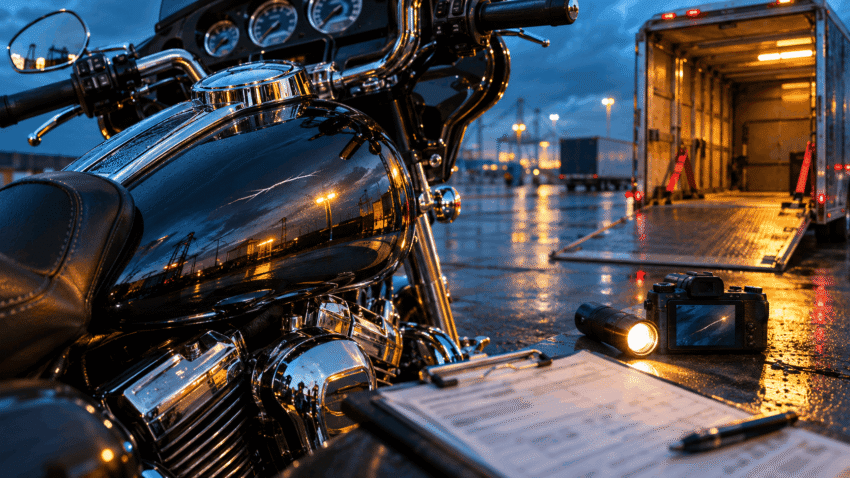

A motorcycle arrives after a long-distance shipment. The owner inspects the fuel tank and notices a scratch that was not there before collection. The driver believes the mark is old. The owner is certain it is new. Neither has a clear photograph showing that part of the motorcycle immediately before loading.
What should have been a routine delivery has become a disagreement over evidence. The problem is no longer simply the cost of repairing the paint. It is whether the available documents establish the motorcycle’s condition before and after transportation, who was responsible for it during the relevant period, and what the shipping agreement actually covers.
This is a hypothetical situation, not a documented claim involving a particular customer or carrier. It illustrates a preventable weakness in vehicle transportation: people often pay close attention to quotes and arrival dates while giving comparatively little thought to the records that may matter if something goes wrong.
For motorcycle buyers, sellers and owners arranging interstate transportation, a good shipping process should begin with accurate condition documentation and a clear understanding of the carrier’s responsibilities.
Why a damage dispute often begins before the motorcycle is loaded
A motorcycle can have minor cosmetic wear that is difficult to notice under ordinary lighting. Small marks may be hidden by reflections, dust, protective accessories or the angle from which the vehicle is inspected.
This makes the collection inspection an important reference point. If the motorcycle arrives with a scratch, dent or damaged component, the owner needs a reliable record against which the delivery condition can be compared.
A general photograph of the complete motorcycle is helpful, but it may not show enough detail to establish the original condition of a specific panel. Close-up photographs of vulnerable components can provide more useful evidence.
Owners should consider documenting the tank, fairings, handlebars, mirrors, exhaust, luggage cases and other exposed areas, depending on the motorcycle’s configuration.
Photographs should be taken before the vehicle is handed over, preferably in adequate lighting. The images should identify the actual motorcycle and preserve sufficient detail to distinguish existing marks from later changes.
It is also useful to record the odometer reading, visible modifications and accessories included in the shipment. These details establish the configuration being transported and help reduce confusion when the motorcycle is received.
The motorcycle’s registration or identification information should be checked against the shipping paperwork. An error in the vehicle identification number or collection address can complicate later communication even when the transport itself proceeds normally.
A properly documented pickup is therefore about establishing an accurate record, not assuming that damage will occur.
The condition report and the bill of lading serve different purposes
Shipping paperwork is sometimes discussed as though every document performs the same function. In practice, a transport agreement, bill of lading, vehicle-condition report and delivery receipt may record different information.
A bill of lading commonly documents important shipment details and the contractual transportation arrangement. A condition report records visible information about the motorcycle at a particular point in the process. A delivery receipt confirms aspects of the handover, although its legal effect depends on the document’s wording and the applicable agreement.
Some transport providers combine several of these functions into a single form. Others use separate documents or electronic inspection systems.
The distinction matters because a signed delivery document may later be examined during a dispute. An owner should understand what the signature acknowledges before signing and should not assume that every form is merely proof that the truck arrived.
Photographs can provide additional context, but they should not replace the written record where the carrier requires condition details or exceptions to be recorded at delivery.
Owners who want to understand how inspection and documentation fit into transportation can consult Cheap Motorcycle Shipping’s transport process guide, which describes motorcycle inspection before shipment and the importance of documenting visible marks.
The practical objective is consistency. The pickup photographs, condition report, vehicle description and delivery documents should all refer to the same motorcycle and should not contradict one another without an explanation.
What shipping insurance actually covers depends on the policy
Motorcycle owners frequently hear that a carrier is insured. That statement is not specific enough to establish what happens if a motorcycle is damaged.
Several different kinds of insurance and liability protection can be involved in commercial transportation. A carrier may maintain automobile liability insurance, cargo coverage or other policies. The purpose, scope and limits of these protections are not interchangeable.
For example, liability insurance addressing bodily injury or property damage arising from the operation of a commercial vehicle is not necessarily the same as insurance covering damage to motorcycles being transported as cargo.
The Federal Motor Carrier Safety Administration publishes insurance-filing requirements that distinguish types of motor carriers and required financial responsibility. Its published chart does not impose the same federal cargo-insurance filing requirement on every category of for-hire property carrier.
That distinction is important when consumers see a registration record or hear that a company meets federal insurance requirements. Neither statement, standing alone, proves that a specific motorcycle has a particular level of protection against transit damage.
Owners should ask for the relevant cargo coverage information and review how the transportation agreement addresses loss, damage, exclusions and liability limits.
Some policies may treat particular components or events differently. Unattached accessories, pre-existing damage, mechanical problems and damage caused by inadequate preparation may raise questions that need to be resolved under the specific wording of the contract and policy.
A quoted coverage amount is also not necessarily a guaranteed payment. A loss may still be subject to applicable deductibles, exclusions, proof requirements, valuation provisions or disputes concerning responsibility.
Before booking, the customer should identify the legal business responsible for transportation and confirm which company would receive a damage claim. That is especially important when a booking service arranges transport through another carrier.
Why the cheapest shipping quote may leave important questions unanswered
Price matters when shipping a motorcycle, particularly when the transportation cost must be added to the purchase price of a used or collectible bike.
However, the lowest initial quote does not necessarily represent the best overall arrangement. Two quotations may involve different pickup conditions, trailer configurations, delivery arrangements or contractual assumptions.
One provider may quote collection from an accessible commercial location, while another may include pickup from a residential address. A shipment requiring additional handling or special arrangements can create costs that were not apparent from the original comparison.
The transport method also deserves attention. Open and enclosed transportation expose a motorcycle to different operating conditions. Enclosed transportation provides a physical barrier against ordinary road exposure, but it should not be described as eliminating every possibility of loss or damage.
Likewise, lower-priced shipping does not automatically imply inadequate protection. What matters is whether the chosen service is suitable for the motorcycle and whether its terms have been understood.
When comparing the alternatives, this explanation of the trade-offs behind lower shipping costs provides context on transport methods and the choices that affect motorcycle shipping expenses.
Customers should request written clarification of what the quoted price includes, which services may incur additional charges, and what responsibilities remain with the motorcycle owner.
Those questions are particularly useful for motorcycles with aftermarket accessories, unusual dimensions or higher-than-typical declared values.
The first inspection at delivery may be the most important one
When a motorcycle reaches its destination, the owner may be eager to complete the handover and get the vehicle home. That is understandable, but the delivery inspection deserves sufficient attention.
The receiver should compare the motorcycle with the original collection record before accepting that its condition is unchanged. If the driver provides a delivery-condition form, any discrepancies should be accurately identified.
The inspection should take place in reasonable lighting where possible. If a delivery occurs after dark or under difficult conditions, the receiver should document those limitations rather than assuming that every surface has been examined thoroughly.
Visible scratches, broken accessories, damaged luggage or other abnormalities should be photographed. The photographs should show both the overall location of the damage and closer details.
For an interstate purchase, the receiving party may not be the same person who originally inspected the motorcycle. That makes access to the pickup photographs and condition report particularly useful.
Where a seller arranges shipment, the buyer should establish in advance who will receive the transport documents and who has authority to report damage. Confusion about these responsibilities can delay an investigation.
Owners arranging a shipment across state lines can use cheapmotorcycleshipping.com/how-to-ship-a-motorcycle-to-another-state/ as a reference for transport planning, collection inspections and delivery checks.
Recording damage at delivery is important, but the receiver should not assume that a brief notation automatically constitutes a complete formal claim. The carrier may require additional information under the governing claim procedures.
How federal cargo-claim rules affect documentation
Motorcycle transportation must be distinguished from household-goods moving when discussing federal consumer protections.
The FMCSA publishes a consumer program called Protect Your Move, with specific rules and guidance for interstate household-goods moves. Those protections should not automatically be transferred to a standalone motorcycle shipment simply because the motorcycle crosses a state boundary.
For interstate cargo transportation subject to the relevant federal framework, 49 CFR Part 370 addresses the processing of claims for loss, damage, injury or delay.
Section 370.3 explains that a written cargo claim generally needs enough information to identify the shipment, assert liability for the alleged loss or damage, and request payment of a specified or determinable amount.
The regulation also explains an important limitation: a damage notation on a delivery receipt, an inspection report or a similar record does not, by itself, necessarily satisfy the minimum requirements for filing a formal cargo claim.
This is why customers should treat the initial damage report and the formal claim submission as separate steps when the governing rules require both.
Applicable filing deadlines must be identified from the transportation agreement and governing law. Consumers should not assume that every motorcycle shipment carries the same deadline used for claims under the federal household-goods moving program.
The appropriate response is to notify the responsible company promptly, request its written claim instructions, and retain evidence of the communication.
The carrier may request photographs, transport documents, ownership information, repair estimates or other material needed to evaluate the reported damage.
The existence of a claim process does not establish that the carrier is responsible for every reported loss. Liability and payment depend on the facts, applicable law, transportation agreement and any relevant insurance provisions.
A repair estimate is useful evidence, but it does not prove when damage occurred
After discovering damage, an owner may obtain an estimate from a motorcycle repair shop or authorized service center.
Such an estimate can identify affected components and the projected cost of restoring the motorcycle. It may also help distinguish cosmetic repair from replacement of damaged parts.
However, the estimate usually addresses the nature and cost of repairs rather than conclusively establishing when the damage occurred.
A repair shop may be able to describe the condition of a component, but it may not have evidence showing whether a scratch existed before collection, occurred during transportation or appeared after delivery.
The claim record is stronger when it combines different kinds of evidence: pickup photographs, a written condition report, delivery photographs, relevant communications and a repair assessment.
Owners should preserve original image files when possible, including their available metadata, and keep copies of the documents received from the transport provider.
They should also avoid making unnecessary changes to disputed damage before the responsible company has had a reasonable opportunity to inspect it, subject to safety needs and the applicable claim procedure.
Where immediate repair is necessary to prevent further loss or address a safety concern, the owner should document the condition carefully and communicate the circumstances to the appropriate party.
The objective is to preserve an accurate account of events rather than construct a version of the incident that the available evidence cannot support.
How buyers and sellers can prevent disputes over responsibility
Motorcycle purchases arranged remotely introduce another complication: the person selling the bike may be responsible for handing it to the carrier, while the buyer takes delivery hundreds of miles away.
Before pickup, both parties should agree on who arranges transportation, who pays for the service, and who is responsible for providing the motorcycle and required documents.
They should also establish who will take photographs, approve the condition report, release the motorcycle and receive the delivery documents.
Ownership transfer and transport risk are related but distinct issues. A sales agreement may address when ownership or risk passes between buyer and seller. A transportation agreement separately governs the relationship with the carrier.
Those documents should be read together rather than assuming that the party paying for transportation automatically bears every possible loss.
Buyers of expensive or restored motorcycles may also benefit from documenting installed accessories and retaining relevant purchase or valuation records. Where additional cargo protection is available, its terms should be understood before shipment begins.
A clear written record can reduce disagreements between the buyer and seller if damage is discovered at delivery. It also helps identify which party should communicate with the carrier or insurer.
The best time to prepare a damage claim is before damage exists
Effective motorcycle shipping documentation does not require an elaborate investigation before every collection. It requires a consistent process and enough attention to establish the vehicle’s condition and the terms of transportation.
Owners should know who is transporting the motorcycle, what coverage or liability terms apply, which documents will be completed at pickup and delivery, and where to send a written claim if a problem is discovered.
A customer should also retain the booking confirmation and the version of the transportation agreement accepted at the time of purchase. Those records can become important if a later dispute involves charges, delivery conditions or the scope of promised services.
Good photographs cannot prevent every incident. A written condition report cannot guarantee an uncomplicated settlement. And an insurance certificate cannot, by itself, establish that every type of damage will be covered.
What these measures provide is a clearer factual record.
If a motorcycle arrives with a new mark, the owner should be able to compare its documented pickup condition with its documented delivery condition and identify the company responsible for reviewing the complaint.
That is a far better position than attempting to reconstruct the original condition from memory after the driver has departed.
For motorcycle shipping, the final few minutes of inspection can be as consequential as the transportation arrangements made weeks earlier. The paperwork and photographs deserve to be treated as part of the shipment itself.
