
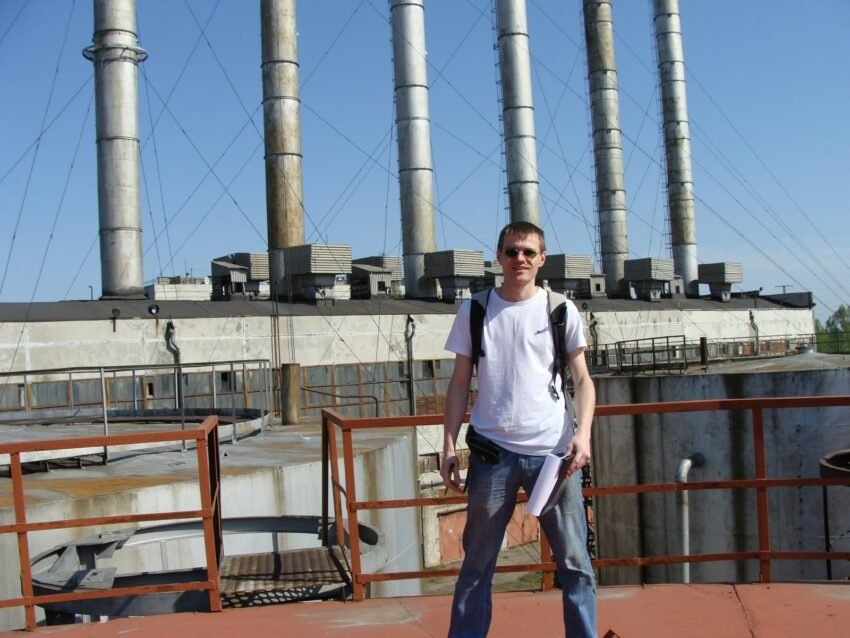

A design engineer is one of those professions where the final product often remains behind the scenes. The user sees a building, road, or reconstructed structure, but they don’t see the calculations, drawings, and engineering solutions that made it possible. Petro Mozil has worked in the construction industry for over ten years, designing, reconstructing, and calculating load-bearing structures. His professional experience includes residential and industrial buildings, boiler houses, infrastructure facilities, warehouses, and commercial complexes. We spoke with the engineer about choosing his profession, the responsibility for design solutions, a wide variety of construction tasks, and why a good specialist never stops learning.
Petro, let’s start from the very beginning. When did you realize you wanted to become an engineer?
– I guess it’s hard to say I decided to become an engineer on one specific day. My interest developed gradually. I liked math at school and participated in math competitions. I was also interested in technical drawing. In my senior year, I took extra classes in drawing and technical drawing, and I really enjoyed it. I realized I wasn’t just interested in solving math problems, but in applying precise knowledge to creating something concrete. At one point, I was choosing between construction and programming. I was interested in both, but construction was closer to me. Here, you can literally see the results of your work.
What did studying at Lviv Polytechnic give you?
– First of all, the foundation. I studied at the Lviv Polytechnic National University, where I received a degree in construction and graduated with honors. During my studies, I participated in competitions and olympiads, exploring various areas of structural engineering. It was important for me to gain not only theoretical knowledge but also to understand how various structures behave. I subsequently worked with wood, metal, and reinforced concrete structures.
You defended your master’s thesis on a rather complex technical topic. Why did you choose this particular subject?
– “I was interested in the strength and load-bearing capacity of structures. My master’s thesis focused on stress losses and the load-bearing capacity of steel-reinforced concrete beams reinforced with rebar”. These topics clearly demonstrate that structural engineering is more than just drawings. Behind every structural element are calculations, physical processes, and an understanding of how the structure will perform in real-world conditions.
Over the years, you’ve been involved in a wide variety of projects. Which experiences have proven most valuable?
– I wouldn’t single out just one project. It was the diversity of tasks that shaped my professional experience. There were new buildings, renovations of existing structures, redevelopments, and structural analysis. I’ve worked with foundations, walls, floors, roofs, frames, columns, trusses, and beams. I’ve worked on residential buildings, commercial and industrial structures, boiler houses, and infrastructure. Each type of project offers something new for the engineer.
Among the projects is the reconstruction of the Rava-Russkaya international automobile checkpoint. This is a rather significant infrastructure undertaking.
– Yes, this is one of the projects I’ve worked on professionally. In general, working with infrastructure projects requires a particularly careful approach to design solutions. Reconstruction always has its own specifics, because the engineer isn’t working from scratch, but on an existing structure. It is necessary to understand the existing structure, its condition, loads, and the specifics of its future operation, and only then make design decisions.
What is more difficult for an engineer: to build something new or to reconstruct something old?
– I wouldn’t say that one is necessarily more difficult than the other. They are different tasks. New construction allows for an initial design concept to be developed and all design stages to be completed sequentially. Renovation introduces an additional factor: the existing building. It’s important to consider the existing structure and find a solution that will modify or strengthen the structure without compromising its reliability. This is why reconstruction requires great attention to detail.
Your experience also includes projects related to heating infrastructure. How does working on a boiler room differ from designing a regular building?
– Each project has its own specifics. My experience includes boiler room renovations, construction of stand-alone and modular boiler rooms, and work with heating infrastructure. This area allowed me to gain additional experience working simultaneously on both engineering and construction projects.
To what extent does a modern engineer depend on computer technology?
– “It’s hard to imagine full-fledged professional work today without them. I’ve used AutoCAD, Lira, Monomah, and SCAD. These programs significantly expand an engineer’s capabilities in design and calculations”. But I always think of a program as a tool. It can perform a calculation, but an engineer must understand the input data, the design, and the resulting output. Responsibility for the decision remains with the specialist.
So, a good engineer must be a mathematician, a designer, and a bit of a psychologist at the same time?
– To a certain extent, yes. An engineer works not only with structures but also with people. You need to understand the client, be able to discuss technical solutions, work in a team, and explain your position. In my work, it’s always been important to quickly understand a problem and find the right solution. Over time, this becomes a distinct professional skill.
What is most important to you when working on a project?
– Responsibility and precision. In construction, you can’t take estimates at face value. You can’t just say, “This is probably good enough.” You need to understand why a particular decision was made and what it’s based on. An engineer must think about how a project will work not only on paper, but also after the facility is built.
You worked in Ukraine for many years, and now you’re continuing your professional journey in the United States. How difficult is it to start a new chapter in a different country?
– “Any new professional environment requires adaptation. But fundamental engineering knowledge and practical experience remain with the individual.” I arrived in the United States in 2022. Now, it’s important for me to continue my professional development, build on my accumulated experience, and adapt it to a new environment. I see this as an opportunity to not start my career anew, but rather continue it at a new stage.
What do you consider your main professional advantage today?
– Experience. Over the years, I’ve seen a wide variety of projects and construction challenges. This allows me to navigate new projects more quickly. Moreover, I always strive to learn. In engineering, you can’t stop at the knowledge you gained at university. Technologies evolve, new tools emerge, approaches change, and a specialist must evolve along with the profession.
You talk about experience, but you once started out with a choice between construction and programming. If you could go back to that moment today, would you make the same choice?
– Yes. I like that construction combines calculations, design, and the practical result. You can see the object and understand that you played a part in its creation. For me, engineering is a profession where there’s always something new to learn. That’s what makes it interesting.
And how do you see the next stage of your professional career?
– “First and foremost, I want to continue working in my field, developing, and using the experience I’ve gained over the years. My professional journey continues, and I’m excited about it.” Ultimately, a good engineer’s result is not a loud statement about himself, but a reliable technical solution that works as intended.
Sergey Ponomarenko
→ For broader coverage, visit our front page.