

Federal investigations reveal how stolen personal information, counterfeit passport cards and synthetic identities can support bank fraud, financial deception and criminal impersonation, prompting stronger identity verification and coordinated enforcement.
WASHINGTON, DC, November 13, 2026 — Counterfeit passports and stolen identities are closely connected in American financial crime investigations, where fraudulent travel credentials can help criminals impersonate legitimate account holders, obtain money and conceal the personal information associated with their activities.
Federal authorities increasingly view passport fraud as part of larger identity theft operations, recognizing that forged identification can support bank fraud, unauthorized financial transactions, and criminal schemes involving personal information taken from unsuspecting individuals.
Recent prosecutions in Texas, Florida, Maine, and other states show how counterfeit passport cards can become tools of financial deception, while emerging synthetic identity techniques create additional challenges for organizations that authenticate customers.
The connection matters because a suspicious passport may represent evidence of several separate offenses, requiring investigators to establish how personal information was obtained, who created the fraudulent credential and whether additional victims remain unidentified.
Counterfeit Passports Connect Stolen Identities With Financial Crime
Identity theft occurs when someone uses another person’s identifying information without lawful authorization, potentially allowing the offender to impersonate the victim during financial transactions, account applications or interactions with organizations that require official identification.
A counterfeit passport can make that impersonation more convincing by presenting stolen biographical details in a document that resembles a government-issued credential, especially when the organization examining it relies heavily on visual appearance.
The link between document fraud and identity theft creates investigative challenges because the apparent passport holder may be entirely innocent, while the person presenting the credential may be using personal information obtained through an unrelated criminal operation.
Investigators therefore examine the underlying identity records, document construction and financial activity together, seeking to distinguish legitimate government-issued identification from fraudulent representations designed to exploit the trust placed in official documents.
Federal Authorities Warn About Counterfeit Passport Card Fraud
The U.S. Treasury Department highlighted these concerns in April 2024 when its Financial Crimes Enforcement Network, working with the State Department’s Diplomatic Security Service, warned financial institutions about counterfeit passport cards used to impersonate customers.
According to FinCEN’s official warning on counterfeit U.S. passport card fraud, authorities identified approximately $10 million in actual losses and another $8 million in attempted losses associated with these schemes between 2018 and 2023.
Federal investigators identified more than 4,000 victims during that period, while cautioning that total losses from fraudulent passport cards and related identity theft were probably higher than the documented figures.
The notice demonstrated why financial institutions cannot regard an apparently genuine passport card as sufficient confirmation of identity without considering the surrounding circumstances, relevant account information and unresolved discrepancies that warrant further investigation.
Texas Investigation Exposes a Multistate Identity Fraud Scheme
A federal investigation in Texas provided another example when authorities uncovered counterfeit passport cards associated with a criminal operation involving stolen personal information, fraudulent banking activity and victims spread across several jurisdictions.
In April 2026, prosecutors announced that Ciera Julieth Blas and Kelly Josek had received federal prison sentences following an investigation that began when officers discovered suspicious identification during a routine traffic stop.
Investigators determined that the operation used identifying information from more than 80 individuals, and authorities later linked additional financial losses and thousands of potential victims to the broader fraudulent activity.
The investigation involved the State Department’s Diplomatic Security Service, local police, and the Secret Service, showing how an encounter involving suspicious identification can develop into a much larger financial crime investigation.
Counterfeit Passport Cards Are Not International Passport Books
An important distinction in these investigations involves the difference between U.S. passport cards and traditional passport books, since the two credentials have different formats, technical characteristics and authorized travel uses.
American passport cards are legitimate government-issued identity and citizenship documents, but they cannot be used for international air travel and should not be confused with the electronic passport books designed for broader international journeys.
Criminals can still manufacture fraudulent versions of either document category, exploiting the confidence banks and other organizations place in official identification when verifying customers or conducting financial transactions.
This distinction matters when evaluating reported passport fraud statistics, since prosecutions involving counterfeit passport cards do not necessarily show that offenders successfully crossed international borders using forged passport books.
Stolen Personal Information Becomes the Foundation of Document Fraud
Counterfeit identification schemes often depend on personal information obtained without authorization, including names, birth dates, addresses, and other details that may allow criminals to impersonate victims during interactions with financial institutions or government agencies.
Such information may originate from mail theft, unauthorized data access or other criminal conduct, making it necessary for investigators to determine whether the individual presenting a counterfeit document also participated in acquiring the underlying records.
In December 2025, federal prosecutors in Mississippi announced prison sentences for four individuals involved in a conspiracy that used stolen identities to create counterfeit passport cards and credit cards for fraudulent banking transactions.
Authorities linked the stolen information to mail theft by another criminal group, showing how separate offenders can contribute to a larger fraud operation without participating in every stage of document production or financial deception.
Synthetic Identity Fraud Introduces Another Security Challenge
Synthetic identity fraud differs from straightforward impersonation because it can involve combining authentic information with fabricated details to create a purported individual whose identity does not match any single real person.
Unlike schemes involving a fully stolen identity, synthetic identity operations can create complex verification challenges when some personal details appear legitimate while other information has been invented or misrepresented.
Federal financial crime authorities have also warned that artificial intelligence can generate deceptive identification images, including images resembling passports, creating additional opportunities for fraud involving fabricated identities and misleading electronic documentation.
These warnings do not mean every synthetic identity involves a counterfeit passport, but they show how fraudulent government-document imagery can become part of broader attempts to defeat customer verification procedures.
Artificial Intelligence Increases Concerns About Identity Verification
Generative artificial intelligence has attracted attention from financial regulators because criminals may use manipulated photographs or fabricated personal details to create misleading identification images for remote account applications and other fraudulent transactions.
The distinction between an altered digital image and a functioning counterfeit passport remains important, since a persuasive photograph does not automatically possess the physical security features or authenticated electronic information found in genuine travel documents.
Organizations relying on remotely submitted identification must therefore understand their verification systems’ capabilities, recognizing that an image that looks consistent with a passport design does not, on its own, establish official issuance.
Investigators examining suspected artificial intelligence fraud also need corroborating evidence because unusual digital imagery alone does not establish criminal intent or prove that an applicant knowingly supplied fabricated information.
Major Data Exposure Reports Raise Identity Theft Concerns
In September 2026, concerns about compromised identity information intensified when reports emerged of an online service allegedly offering millions of digital images of driver’s licenses linked to individuals in the United States and Canada.
As Reuters reported in its September 2 investigation, the FBI was examining allegations involving a dark web listing that purported to contain extensive identification records, although the complete source and scope of the alleged exposure remained uncertain.
The report showed why stolen identity images attract law enforcement attention, especially when digital copies of official credentials could support impersonation attempts involving financial accounts or other services that require customer verification.
However, the reported availability of identification images does not establish that counterfeit passports were produced from those records, making careful distinctions essential when discussing the possible consequences of compromised personal information.
Florida Case Shows How False Documents Support Bank Fraud
A September 2026 federal prosecution in Florida showed another link between stolen identities and counterfeit passport cards when authorities announced a prison sentence for fraudulent banking transactions and unauthorized customer information.
Prosecutors reported that Vontavius Jamaal Bradley received a 42-month federal prison sentence after pleading guilty to offenses involving bank fraud, false passport use and aggravated identity theft within a broader conspiracy.
The operation involved obtaining personal information belonging to legitimate individuals, establishing bank accounts under misleading identities and using fraudulent documents alongside stolen or counterfeit checks to obtain money.
Authorities also ordered restitution to financial institutions and identity theft victims, demonstrating how criminal cases can address both the fraudulent transactions and the financial harm experienced by individuals whose information was misused.
Financial Institutions Become Important Fraud Detection Partners
Bank employees may encounter counterfeit passport cards when individuals attempt unauthorized withdrawals or seek account access using documents that display another person’s identifying details alongside a misleading photograph.
These encounters can create opportunities to identify suspicious activity before additional financial losses occur, particularly when staff recognize inconsistencies between presented credentials, customer records and established account information.
Financial institutions must nevertheless apply verification procedures consistently, recognizing that an unfamiliar document, changed appearance or legitimate name difference does not independently establish identity theft or justify unsupported accusations against a customer.
The most effective response combines appropriate customer identification, documented escalation procedures and lawful reporting of suspicious activity, helping investigators determine whether observed discrepancies reflect deliberate deception or explainable administrative circumstances.
Modern Passport Security Creates Multiple Verification Layers
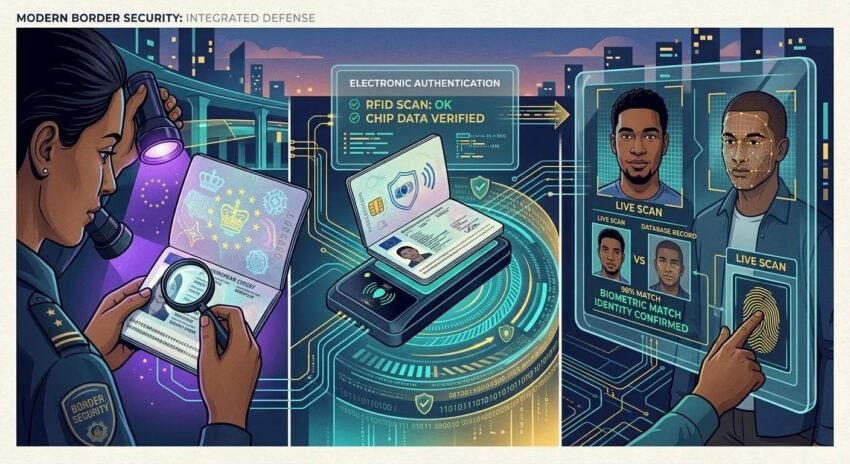
Contemporary passports incorporate specialized materials, protected identity pages and electronic authentication capabilities intended to make certain forms of document counterfeiting more difficult while providing trained inspectors with opportunities to identify inconsistencies.
As explained in Amicus International Consulting’s examination of modern passport security and counterfeit detection, physical security examination, electronic authentication, and biometric identity comparison perform different functions that should be evaluated together rather than treated as interchangeable guarantees.
Electronic passport chips can contain digitally signed identity information, allowing compatible inspection systems to determine whether protected data corresponds to an authorized issuing authority and whether that information has changed since issuance.
These mechanisms cannot independently establish that every detail supplied during the original passport application was truthful, making reliable enrollment procedures and accurate government identity records essential components of document security.
Biometric Verification Helps Expose Identity Impersonation
Facial recognition can supplement document examination by comparing individuals with trusted identity images, potentially identifying situations where someone other than the rightful holder presents a genuine credential during an authorized inspection.
The technology addresses an important limitation of physical security features because a stolen passport may contain authentic printing, valid electronic information and an accurate government signature while being improperly possessed.
Automated biometric comparisons nevertheless require careful interpretation because technical limitations, image quality and changes in appearance can affect results, making additional review necessary when a system identifies an unresolved discrepancy.
Identity Fraud Investigations Require Cooperation Across Agencies
Passport-related identity theft investigations can involve federal prosecutors, local police, the State Department’s Diplomatic Security Service, and financial crime specialists, whose different responsibilities help connect documents, victims, and transactions.
Information sharing may help investigators recognize apparently unrelated fraudulent identification as evidence of a broader operation, provided that relevant findings are supported by reliable records and handled according to applicable legal requirements.
The importance of cooperation extends to victim protection because investigators may identify individuals whose stolen information has circulated through several criminal schemes without their knowledge or authorization.
Victims Can Face Consequences Beyond Financial Losses
People affected by identity theft may encounter unauthorized banking activity, disputed accounts and inaccurate personal records, requiring substantial effort to establish that transactions conducted under their names were fraudulent.
Fraudulent identification can worsen these problems when a criminal presents a convincing government-document image, potentially causing institutions to link the victim’s legitimate identity to activities the person never authorized.
Protecting affected individuals therefore requires effective investigation, accurate record correction and cooperation among relevant institutions, while avoiding assumptions that every person whose identity appears in a suspicious document participated in criminal activity.
Passport Fraud Remains a Broader Identity Security Problem
The connection between stolen identities and counterfeit passports demonstrates why government document security must extend beyond attractive designs and sophisticated electronic chips to include trustworthy application records and reliable identity verification.
For investigators, a fake passport may provide evidence of financial deception, unauthorized use of personal information or other criminal conduct, making careful examination of the surrounding circumstances essential to establishing responsibility.
Ultimately, protecting legitimate identities requires coordinated enforcement, secure government records and layered document authentication, ensuring that technological improvements address both counterfeit credentials and the wider criminal activity they may support.
