
Skip to content
The Times USA
Menu
  • ABOUT
  • CONTACT
  • LIFESTYLE
  • NATIONAL NEWS
  • BUSINESS
  • INTERNATIONAL NEWS
  • TECHNOLOGY
  • PRICE OF BUSINESS SHOW AUDIOS
Menu

Lower standards? The truth behind chemicals allowed in America, but BANNED elsewhere

Posted on April 9, 2020July 9, 2020 by David Jackson

The nature of the world means that there are always going to be differences in the way in which countries deal with certain issues. There are rarely going to be a duplicated set of regulations, even if nations operate under an umbrella like the European Union.

However, an infographic has highlighted some intriguing regulations in relation to chemicals which are consumed in America.

Parker & Waichman LLP have put together the following image, which looks at twelve chemicals which are consumed in the country, but banned in a lot of others:
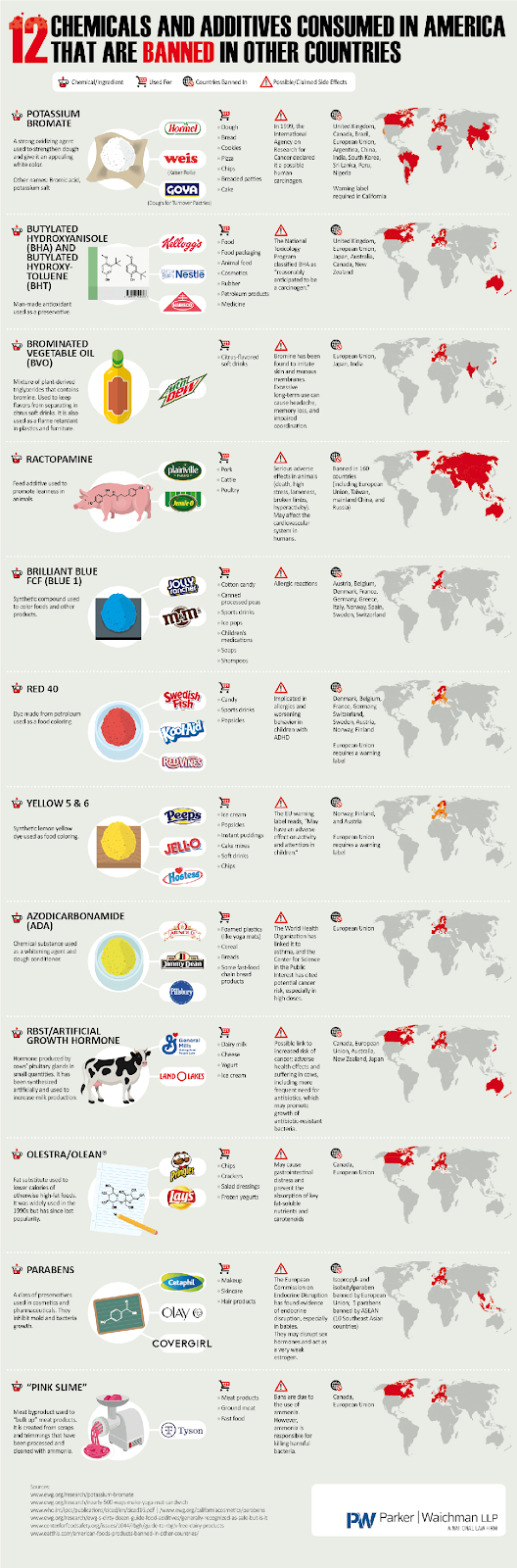
Worryingly, most of the chemicals are related to foods. For example, out of the 12, the following are directly consumed by humans:

  • Potassium Bromate
  • Butylated Hydroxyanisole
  • Brominated Vegetable Oil
  • Brilliant Blue FCF
  • Red 40
  • Yellow 5 & 6
  • Azodicarbonamide
  • RBST
  • Olestra
  • Pink Slime

In addition, other chemicals that made the list were indirectly consumed by humans. For example, in the case of Ractopamine, this is a feed that is given to pork, cattle and poultry (and subsequently, later down the food chain, consumed by humans). Or, with Parabens, which are used in makeup products.

A lot of these chemicals aren’t necessarily available from the supermarkets in transparent containers, but are instead found within foods and products that Americans consume on a day-to-day basis.

All of the twelve chemicals listed are associated with damning studies which suggest that they cause far more harm than good. Some are regarded as carcinogens, while others have been found to cause allergic reactions.

The European Union tends to take the strictest stance with these chemicals and either bans them completely, or at least attaches clear warning labels to them. In the case of Ractopamine, this has seemingly caught the attention of most of the world and has been banned by no fewer than 160 countries. However, it continues to be sold to American farmers in a bid to promote lean animals.

Interestingly, the United States has the fifth worst rate for cancer in the world. We’ll leave you to decipher the infographic in full and draw your own conclusions on any possible correlations.

You Might Also Like...

  • The Process behind any New Product Development

    Companies are creating new products every day in order to stay competitive. The product developing…

  • The Winter White House is Eight Miles from one of America's Murder Capitals - and it isn't Where You Think

    NeighborhoodScout, a web-based platform from Location, Inc. that delivers custom crime risk and real estate market…

Leave a Reply Cancel reply

Your email address will not be published. Required fields are marked *

VIDEO: This Week’s Best of our Network

https://www.youtube.com/watch?v=taN65F63jbA

GDPR Compliance

USABR does not collect data on its visitors.  For more information visit: https://www.usabusinessradio.com/contact-us/

Contact

Contact articles@usabusinessradio.net for more information on articles on this site. BMuyco@usabusinessradio.net for all other information.

Recent Articles

  • An Unconventional Look on How Businesses Can Save Their Clients
  • A Step-by-Step Guide for a Business Owner Planning Their Exit
  • Rep. Haley Stevens Makes the Case for Accountability at HHS
  • The Search for a Field Sales Management Tool
  • How To Respond When a Contractor Goes Rogue: A Crisis Management Guide

Also in TTUSA

  • The Inauguration of Donald J. Trump: A Media Wrap Up
  • Bestselling Author Visits the Price of Business on the Demise of Free Speech
  • Attention Dog Owners: 6 Reasons Why You Need To Own BarxBuddy
  • Global Travel Trade The First Hotel Counter Service was Successfully Opened
  • Meet Mark Kinnebrew: One of the Best Trainers/Coaches in the Game

RSS The Daily Blaze

  • Former Venezuelan Political Prisoner on What Comes Next for the Country
  • Why Maduro? News Media Coverage Is Weak
  • What Happens Next in Venezuela?
  • It Seems Wesley Hunt Is MIA in US Senate Race
  • Sizing Up CBS Censorship Efforts on 60 Minutes

RSS USA Business Radio

  • The Hidden Dangers of Allowing Non-Attorneys or Unregulated Entities To Hold Third-Party Funds
  • The Internal Business Risks That Many Owners Underestimate
  • AI Art Market: How Blockchain Proves Your Digital Masterpiece’s Authenticity and Value
  • The Power of Mentorship With Monnica Rose
  • Be Serious About Potential Risks Facing Your Company

RSS USA Daily Times

  • Gut Instincts: The Real Reason You Crave Sugar
  • International Bestselling Author on Her Latest Jewish Romance Novel
  • 5 Most Profitable Small Businesses in the UK for Fresh Graduates With Low Investment
  • Beyond Command: Lead With Flow & Momentum
  • Luxury Travel Within Reach

RSS USA Daily Chronicles.

  • Life After Ownership – Planning Your Purposeful Next Chapter
  • National Diabetes Month Spotlight
  • 10 Ethical ChatGPT Prompts for Answering Assignments Every Student Can Use (2025–26 Guide)
  • The Price of Pet Food
  • Part One: Rethinking Nutrition in America — a Conversation With Marion Nestle, Ph.D., M.P.H.

RSS Price of Business

RSS US Daily Review

  • The Case for Local Law Enforcement
  • The Silent Exposure to America’s Nuclear Weapons Technicians
  • Maduro in New York: From Indictment to Custody
  • Why Did Trump Reject Maduro’s Offer?
  • Unboxing Trump’s View of Affordability

PoB Digital Network

US Daily Review

USA Business Radio

USA Daily Chronicles

USA Daily Times

The Daily Blaze

The Times USA

Price of Business

Privacy Policy

https://www.thetimesusa.com/privacy-policy-2/

© 2026 The Times USA | Powered by Superbs Personal Blog theme