

With an estimated 270 million Americans viewing their smartphones about 14 billion times per day, the smartphone continues to reign supreme as consumers’ preferred device for online actions, as well as for controlling and monitoring many daily activities, according to Deloitte’s U.S. edition of the “2018 Global Mobile Consumer Survey.” This year smartphone penetration rose to 85 percent, up 3 percent from 2017, with the strongest growth among U.S. consumers aged 45 and over.
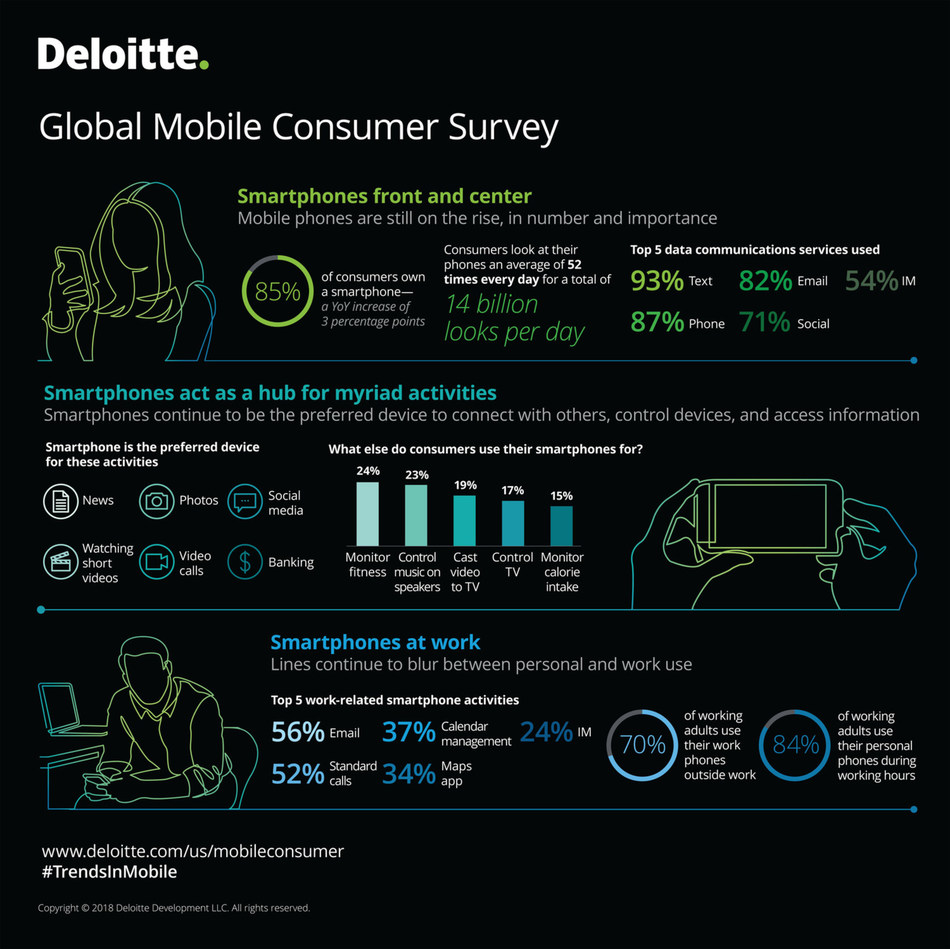
American consumers are now viewing their phones an average of 52 times daily, with 39 percent of consumers believing they use their smartphones too much. In fact, 60 percent of 18 to 34-year-olds admit to smartphone overuse, the highest level of any age group. However, 63 percent of the respondents reported trying to limit their smartphone usage, roughly half succeeding in cutting back. Smartphones also are helping blur the lines between work and leisure with 70 percent of respondents using personal smartphones at least occasionally for after-hours work.
The survey also notes growing consumer interest in voice-assisted technologies, which are poised to be one of the next “big things” in human-computer interaction, as well as interest in certain Internet of Things (IoT) applications and devices, and the introduction of fifth-generation (5G) wireless technologies.
“This year’s survey really advances the story of smartphones as the true center of our lives, both inside and outside the home,” said Kevin Westcott, vice chairman and U.S. telecommunications, media and entertainment sector leader, Deloitte LLP. “While interest in other mobile technologies such as voice-assistance and IoT is there, the smartphone remains the go-to device for consumers, enabling them to do anything they desire: communicate, work, socialize, consume entertainment, stay fit or take care of things at home.”
Inflection point for tablets and wearables
While smartphone penetration continued to increase this year, the same was not true for tablets. They suffered the largest year-over-year decline in market penetration of any device category, per the survey, slipping 5 percent (from 62 percent to 57 percent) and seem to now have more specific uses among different age groups.
- Smartphones are the fastest growing of 10 device categories. Their 3 percent growth rate is triple that of the one other device category with positive growth, smartwatches, now used by 14 percent of Americans.
- Trailing smartphones in consumer penetration are laptops (77 percent), desktop computers (57 percent), tablets (57 percent), fitness bands (21 percent), virtual reality (VR) headsets (8 percent) and smartwatches (14 percent).
- In daily usage, tablets (52 percent) now rank behind smartphones (94 percent), laptops (74 percent), desktop computers (71 percent), smartwatches (67 percent), and fitness bands (60 percent).
- Daily usage for wearables, however, is growing for owners of fitness bands (60 percent versus 53 percent in 2017) and smartwatches (67 percent versus 62 percent in 2017).
Consumers concerned about data privacy and security
Not surprisingly, an overwhelming majority of Americans worry about keeping their personal data private.
- Eighty percent of consumers have concerns about companies using, storing and sharing their personal data with third parties.
- Eighty-five (85) percent of respondents now believe that companies with which they interact online use their personal data “all” or “most of” the time.
- Consumers are 14 percent less likely this year to share their photos and address books with companies they interact with online, marking a substantial change in behavior from last year.
- With regard to mobile in-store payments (mPayments), only 31 percent of respondents indicated they have ever used their mobile device to make an in-store payment, and only 14 percent do so on a weekly basis. While there are several reasons for the tepid adoption, security concerns (42 percent) and lack of perceived benefits (42 percent) were cited as main reasons by respondents.
Voice assistant technologies “make noise” with consumers
Voice control’s adoption curve suggests it will be the next big thing in human computer interaction, after touch.
- Nearly two-thirds (64 percent) of respondents have used the voice assistant on their smartphones, up 11 percent from last year.
- Nearly half (46 percent) have used the voice assistant within the last week, if not in the last day.
- Market penetration of voice-assisted speakers has nearly doubled over the past year (growing from 12 to 20 percent).
- Sixty-nine (69) percent of respondents who own voice-assisted speakers report using their voice-assistance capabilities weekly, and 47 percent do so daily.
IoT intrigues, but will consumers pay?
Connected devices are everywhere, but consumers’ interest in them is mixed. Plus, for the first time in recent years, we saw a dip in consumers’ interest in self-driving cars.
- Eighty-five (85) percent of respondents expressed interest in the connected car and 73 percent expressed interest in the connected house.
- However, fewer than 50 percent of respondents are willing to pay for any connected car service (route tracking, maintenance, traffic updates, etc.) – down an average of approximately 4 percent across the board from last year.
- While survey respondents view home-control (55 percent) and home-monitoring solutions (53 percent) as having the greatest potential value, only slightly over half say they are willing to pay for connected home products and services.
- The number of respondents who would buy a self-driving car dropped 6 percent from 2017 (24 percent).
- Additionally, the number of respondents who would ride in someone else’s self-driving car was also down 8 percent from 2017 (41 percent).
Consumers eager for 5G networks and devices
As people demand more from their devices, consumers want faster data speeds, lower latency, improved responsiveness and better performance among connected devices. That bodes well for 5G’s enormous capacity networks and smartphones.
- Overall, 60 percent of respondents indicated that 5G is either “fairly” (34 percent) or “very” (26 percent) important to them now, compared with 55 percent who felt that way a year ago.
- That interest rose across all age groups over the past year — even among those aged 65 and over, who saw a 9 percent jump to 31 percent.
- The perceived importance of 5G is highest among the 25-34 age group (77 percent believe it’s either fairly or very important).
- Interestingly, 29 percent of respondents said their current 4G/LTE network speed at home is either a little or much faster than their home Wi-Fi, compared to 27 percent in 2017.
“This year’s survey confirms that while smartphones are becoming the nerve center of our homes, our businesses, our families and our lives — consumers are craving more speed and responsiveness as their usage patterns mature,” said Mic Locker, managing director in Deloitte Consulting LLP’s Technology, media and telecommunications industry practice. “It will be interesting to watch the availability of 5G networks and 5G-enabled smartphones over the next year to see if consumers’ yearning for better performance is satisfied.”
Industry outlook
While smartphone usage and behaviors are maturing, the report cites several trends that may be of interest to telecommunications carriers including:
- The average age of smartphones is increasing with more than 80 percent of smartphone owners purchasing their latest phone within the last two years. Younger consumers have a relatively faster replacement cycle.
- Notably, we are also seeing an increase in the numbers of respondents who have a second phone, as more than a third of those surveyed (34 percent) responded that they kept their previous phone as a spare when purchasing a new device.
- Approximately 2 in 3 smartphone owners purchased their current phone in a walk-in store, and 1 in 3 purchased it online, which is fairly consistent with past surveys.
- Most in-store purchases are made at carrier stores (69 percent, up from 67 percent last year), and most online purchases are made from carrier websites (50 percent this year, up from 47 percent).
- Online sales from phone manufacturer websites almost doubled, albeit from a base of 8 percent last year to 14 percent this year.